
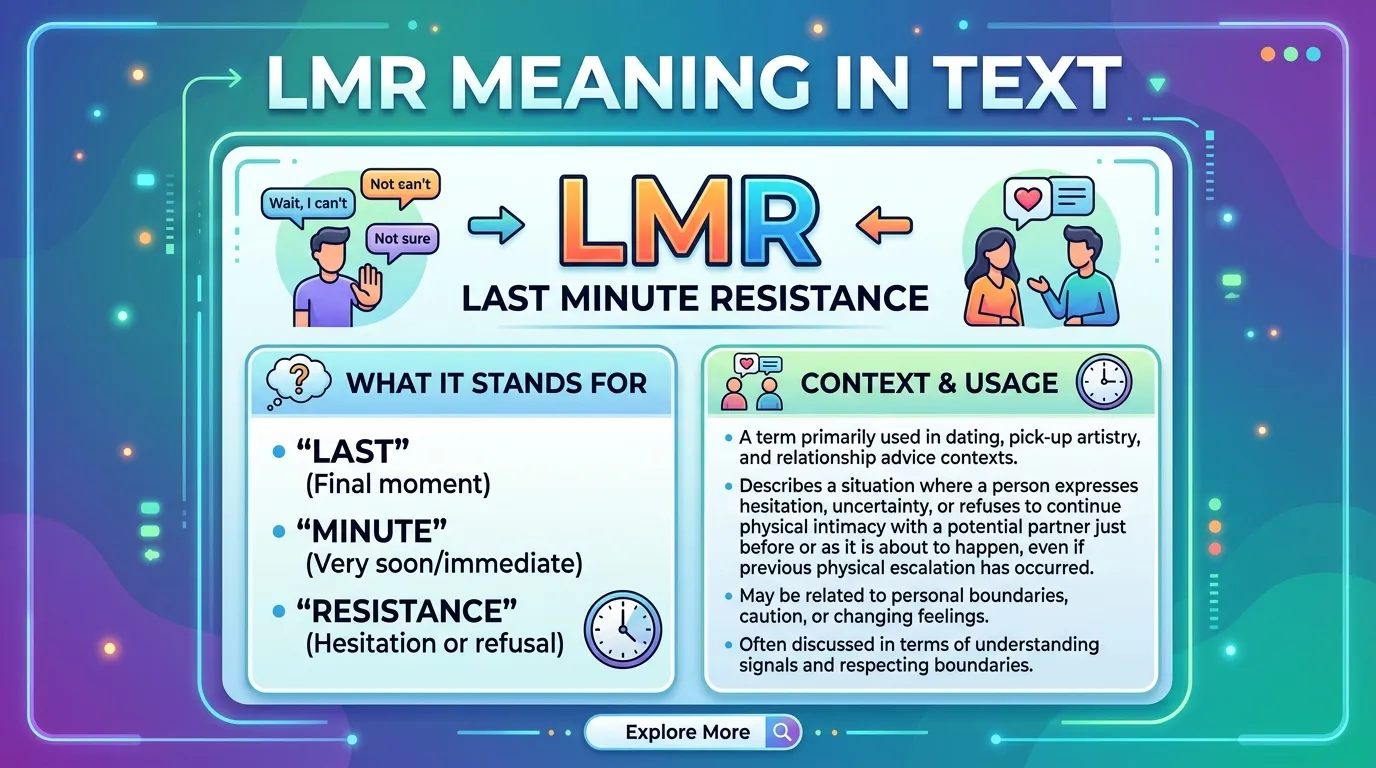
Have you ever received a message that simply said “LMR” and wondered what it meant?
You’re not alone. Internet slang changes quickly, and new abbreviations appear on Snapchat, TikTok, Instagram, and texting apps all the time.
The first time many people see LMR, they assume it’s a typo or a random set of letters. However, it actually has a specific meaning depending on the conversation.
Quick Answer:
LMR means “Like My Recent.” It’s a casual and social-media-friendly abbreviation people use to ask others to like their latest Instagram, TikTok, Facebook, or other social media post.
What Does LMR Mean in Text?
In texting and social media, LMR stands for “Like My Recent.” It’s commonly used when someone wants their friends or followers to like their newest post or photo.
Instead of typing the full phrase, users simply write LMR, making the message shorter and faster.
Example
Alex: just posted a new pic 📸
Sam: lmr 😄
Here, Sam is asking Alex—or anyone reading the conversation—to like the most recent post.
In short: LMR = Like My Recent = Please like my latest social media post.
Where Is LMR Commonly Used?
You’ll mostly see LMR on social media platforms where likes and engagement matter.
- 📱 Instagram – Asking friends to like the newest photo or Reel.
- 👻 Snapchat – Sent in chats or stories to encourage engagement.
- 🎵 TikTok – Used after uploading a new video.
- 💬 Text Messages – Friends reminding each other to support a recent post.
- 🎮 Gaming Chats – Occasionally used between friends who also follow each other on social media.
- 📘 Facebook – Requesting likes on a new photo or status.
Tone
- ✅ Casual
- ✅ Friendly
- ✅ Social-media friendly
- ❌ Not suitable for formal communication
Examples of LMR in Conversation
Example 1
A: just uploaded vacation pics 🌴
B: lmr 😄
Example 2
A: check out my new reel!
B: sure, lmr 👍
Example 3
A: i finally posted it 😂
B: lmr and i’ll comment too!
Example 4
A: new profile picture!
B: lmr ❤️
Example 5
A: don’t forget my latest post 😅
B: already did! 👍
Example 6
A: i need more likes 😂
B: send the link lol
Example 7
A: lmr please 🙏
B: done! 😊
When to Use and When Not to Use LMR
✅ When To Use
- Asking friends to support your latest post.
- Casual conversations.
- Snapchat streak chats.
- Instagram DMs.
- TikTok messages.
- Friendly group chats.
❌ When Not To Use
- Business emails.
- Professional work chats.
- School assignments.
- Customer support messages.
- Serious discussions.
- Emergency situations.
| Context | Example Phrase | Why It Works |
|---|---|---|
| Friend Chat | “LMR 😄” | Casual and friendly |
| Instagram DM | “lmr please ❤️” | Quick engagement request |
| TikTok Chat | “LMR if you get a chance.” | Natural social media slang |
| Work Chat | “Please review my update.” | Professional wording |
| “Please review my latest submission.” | Clear and formal |
Similar Slang Words or Alternatives
| Slang | Meaning | When to Use |
|---|---|---|
| LML | Like My Latest | Asking people to like your newest post |
| LB | Like Back | Returning someone’s like |
| F4F | Follow for Follow | Growing followers |
| SFS | Shoutout for Shoutout | Promoting each other’s accounts |
| CF | Close Friends | Instagram Close Friends stories |
| DM | Direct Message | Private conversations |
Is LMR Rude or Offensive?
No. LMR is not rude or offensive. It’s simply a friendly request asking someone to support your latest social media content.
However, sending LMR repeatedly can become annoying. It’s best to use it occasionally with friends rather than constantly asking everyone to like your posts.
Common Mistakes When Using LMR
Many people misunderstand LMR because it isn’t as widely known as abbreviations like LOL or BRB.
Here are some common mistakes:
- Thinking it means “Last Message Received.”
- Using it in professional emails.
- Sending it to people who don’t use social media.
- Assuming everyone knows the abbreviation.
- Overusing it in every conversation.
If someone doesn’t recognize LMR, simply explain that it means “Like My Recent.”
Tips for Using LMR Naturally
To make your messages sound natural:
- Use it with friends.
- Pair it with emojis like ❤️, 😄, 👍, or 🙏.
- Use it after posting new content.
- Don’t spam multiple chats with the same request.
- Be supportive by liking others’ posts too.
For example:
This sounds much friendlier than repeatedly demanding likes.
Why Is LMR Popular?
Social media platforms encourage engagement through likes, comments, and shares. Because of this, users often remind friends to support their newest uploads.
Typing LMR saves time while clearly communicating the request.
Its popularity has grown because it’s:
- Short
- Easy to type
- Common among younger users
- Frequently used on Instagram and Snapchat
- Helpful for increasing engagement
FAQs About LMR
What does LMR stand for in texting?
LMR stands for “Like My Recent.”
Is LMR only used on Instagram?
No. It’s also used on Snapchat, TikTok, Facebook, and other social media platforms.
Is LMR formal?
No. It’s informal and best used with friends.
Can I use LMR in business emails?
No. Write the complete message instead of using internet slang in professional communication.
Does LMR mean the same thing everywhere?
Usually yes, although abbreviations can have different meanings in different communities. On social media, Like My Recent is the most common meaning.
Is LMR the same as LML?
They’re very similar. LMR means Like My Recent, while LML means Like My Latest.
Why do people say LMR?
They’re asking others to like their newest social media post.
Should I reply to LMR?
If you’re friends with the sender and want to support them, you can simply like their recent post or reply with “done! 👍”
Final Thoughts
LMR is a simple internet abbreviation that stands for “Like My Recent.” It’s commonly used on Instagram, Snapchat, TikTok, and other social media platforms when someone wants friends to like their latest post.
Since it’s casual and social-media-focused, it’s perfect for chats with friends but should be avoided in professional communication.
Once you know what LMR means, you’ll easily recognize it the next time it appears in your messages.

Mark Twain was an American author born November 30, 1835, in Missouri. He wrote classics like The Adventures of Tom Sawyer and Adventures of Huckleberry Finn, known for real dialogue and sharp humor. He influenced American literature with his clear style and social insight. Read more about him on meaningdesk.com.
 J. K. Rowling
  H. G. Wells